Smooth Council Approvals
Avoid development delays with comprehensive reports tailored to Wyndham planning criteria.
Formal AQF Level 5 arborist assessments for planning permits, development applications, tree protection, and risk management.
Consulting arborists servicing Hoppers Crossing and Wyndham development sites
When planning a subdivision, extension, or applying to Wyndham City Council for vegetation removal, an arborist report Hoppers Crossing provides the certified technical evidence required.
Wyndham City Council actively works to increase urban canopy coverage. Planning permit applications involving native vegetation, developments near Skeleton Creek (ESO1), or subdivisions must present robust arborist reports demonstrating adherence to AS4970 protection standards.
Avoid development delays with comprehensive reports tailored to Wyndham planning criteria.
Identify viable trees early to design building footprints that maximise usable space while protecting canopy value.
Obtain documented evidence of tree condition to manage liability, neighbour disputes, or insurance obligations.
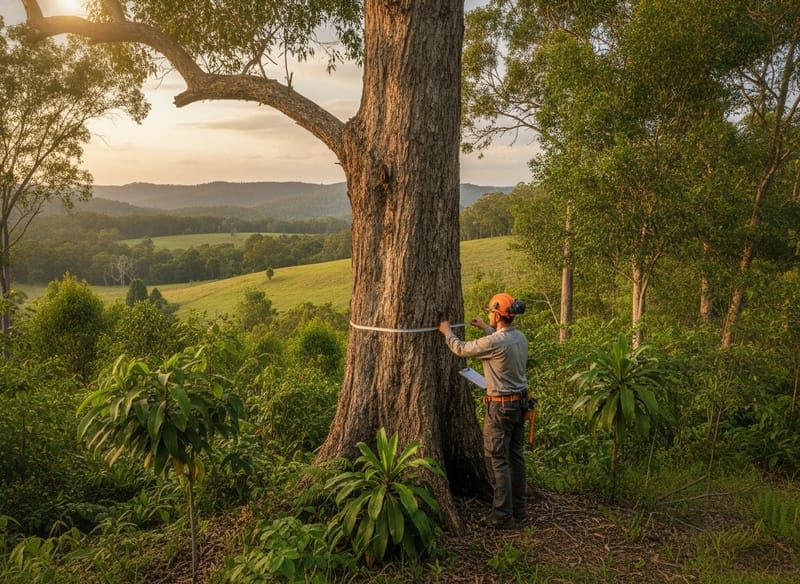
Our AQF Level 5 arborist visits the site to record species, DBH, height, canopy spread, health, and structure.
We overlay proposed building designs to calculate TPZ and SRZ encroachments under AS4970.
We compile a structured, defensible report with tree matrices, site maps, and retention recommendations.
You receive a complete digital PDF report ready for direct submission to Wyndham City Council or private certifiers.
If you are planning a subdivision, managing a commercial property, or dealing with a hazardous River Red Gum on your block, getting an Arborist Report Hoppers Crossing is often your mandatory first step. As Wyndham continues to expand, navigating the Wyndham Planning Scheme, development applications, and local overlays requires precise, professional documentation. We are your local team of consulting arborists, providing detailed, compliant reports for builders, developers, and homeowners across Hoppers Crossing, Werribee, and the surrounding suburbs.
Hoppers Crossing features a unique mix of 1970s properties with large, established trees and newer infill developments where space is tight. Whether you need to satisfy a Section 173 agreement, map a Tree Protection Zone (TPZ) for a new build, or officially document a declining mature tree for safe removal, our AQF Level 5 arborists deliver the exact paperwork council and building certifiers demand.
We understand the heavy, reactive sodic clay soils of the Werribee plains and the specific environmental stressors that affect our local canopy. From drought shrinkage to sudden summer limb drop, we ensure your report is both scientifically accurate and highly localised, giving you the best chance of a smooth, delay-free approval process.
Navigating council approvals and development sites without a qualified consulting arborist is a fast track to costly delays and legal headaches. A simple letter from a tree lopper, a gardener, or even an AQF Level 3 climbing arborist will not satisfy the Wyndham City Council when a formal planning permit is on the line. If your documentation lacks proper AS4970 tree protection mapping or fails to accurately assess Structural Root Zones (SRZ), certifiers will reject your application instantly, holding up your build and costing you thousands in holding fees. Furthermore, attempting to self-assess tree health on properties near waterways like Skeleton Creek or the Werribee River can inadvertently trigger breaches of the Environmental Significance Overlay (ESO). Property owners who remove vegetation without realising they sit inside an overlay or native vegetation zone face immense fines and mandatory offset replanting costs. Our solution is straightforward: we provide fully accredited, AQF Level 5 arborist reports tailored precisely to your situation. From detailed Visual Tree Assessments (VTA) to full Development Application (DA) reporting, we map out exact tree species, trunk diameter, and Safe Useful Life Expectancy (SULE). By bringing our team in early, you ensure your project complies with all local planning schemes, eliminating guesswork and protecting you from project standstills.
Our consulting arborists utilise industry-leading assessment techniques and standardised methodologies to deliver accurate, objective, and council-ready documentation. We ensure every data point stands up to rigorous regulatory scrutiny.
We conduct detailed tree inventories for development sites. We calculate Tree Protection Zones (TPZ) and Structural Root Zones (SRZ) based on trunk diameter at breast height (DBH), detailing the temporary fencing, root mapping, and supervised work zones required by council for any retained trees during construction.
Our team conducts thorough Visual Tree Assessments following industry-standard principles. We document structural defects, evaluate target zones (like houses, footpaths, or powerlines), and calculate the likelihood and consequence of failure. This is crucial for schools, strata properties, and neighbour dispute resolution.
For acreage properties and lots over 0.4 hectares, we meticulously document indigenous vegetation proposed for removal, lopping, or destruction. We ensure complete compliance with the Victorian DEECA guidelines and outline the required ecological offsets and replanting obligations.
When a tree is protected by a local overlay, developer covenant, or title restriction, we provide the formal evidence of its decline, disease, or structural instability needed to justify its removal to the council. This includes a detailed analysis of failure potential and remaining useful life.
Comprehensive diagnostics of tree health, focusing on local stressors. We assess the impact of drought shrinkage in our heavy clay subsoils, which often loosens root plates in mature River Red Gums and planted exotic conifers, providing actionable recommendations for retention or removal.
Securing your report with our team is a streamlined, professional process designed to keep your project moving without unnecessary bureaucratic delays.
Every report we produce is authored by an AQF Level 5 Diploma-qualified consulting arborist, the exact standard required by the Wyndham City Council for planning and development applications. Our methodologies strictly adhere to AS4970 Protection of Trees on Development Sites and reference AS4373 Pruning of Amenity Trees where maintenance or structural pruning is recommended.
We operate fully covered by robust public liability and professional indemnity insurance, giving developers, builders, schools, and homeowners complete financial peace of mind. We also align our replanting schedules with AS2303 Tree Stock for Landscape Use, ensuring that any mandated offset planting meets the highest nursery standards. When you engage our team, you are backed by verified, legally sound documentation.
Operating in the local area requires a deep understanding of the region's specific landscape and climate. The flat basalt plains of the Werribee region sit in a rain shadow, making it one of the driest parts of southern Victoria. When compiling an Arborist Report Hoppers Crossing, we factor in how this dry climate and heavy, reactive clay soil impacts tree stability, particularly for aging River Red Gums and Drooping Sheoaks that are prone to sudden limb drop during summer heatwaves.
While the Wyndham City Council does not have a blanket local law protecting all private trees, properties over 0.4 hectares or those situated near waterways like Skeleton Creek are heavily regulated. Newer estates often carry strict developer covenants or Section 173 agreements that mandate arborist approval before removing established exotics like Bhutan cypress or Canary Island date palms. We know exactly which triggers apply to your specific address, ensuring your report addresses the precise planning instruments governing your land.
Once you receive your arborist report, the next steps depend entirely on the document's purpose. For development sites, you must implement the specified Tree Protection Zones (TPZ) before any heavy machinery arrives on site. Ensure that protective fencing remains intact and mulch layers are maintained throughout the construction phase. If your report recommends hazardous tree removal or AS4373-compliant structural pruning, you can seamlessly transition from our consulting team to our AQF Level 3 climbing arborists to execute the physical work. Keep your digital report securely on file, and call our team back if construction plans change or when you need final arborist certification to close out your building permit.
Arborist report fees in Hoppers Crossing depend on the number of trees and the scope of assessment required.
We provide upfront fixed quotes based on your specific project scope.
Our consulting arborists produce reports across Hoppers Crossing and all Wyndham growth areas.
Contact our consulting arborists for professional reports that satisfy Wyndham City Council.
Request a Report Quote