Smooth Council Approvals
Avoid costly planning delays with detailed reports formatted to Wyndham Planning Scheme requirements.
Comprehensive AQF Level 5 arboricultural assessments for planning permits, risk management, and council compliance.
Providing consulting services for residential, agricultural, and commercial sites in Little River
Whether you are building a new rural dwelling, subdividing land, managing mature trees near public areas, or resolving a permit condition, an arborist report Little River provides the authoritative assessment you need. Our AQF Level 5 arborists evaluate tree health, retention value, and hazard potential to deliver clear, compliant reports.
Planning permits near the Little River waterway require strict adherence to ESO1 schedules to protect riparian biodiversity. Our reports clearly detail native vegetation offsets, tree retention values, and construction impact mitigations.
Avoid costly planning delays with detailed reports formatted to Wyndham Planning Scheme requirements.
Accurate TPZ calculations let builders and architects design around valuable trees with confidence.
Documented arborist evaluations provide defensible evidence for property risk management and insurance needs.
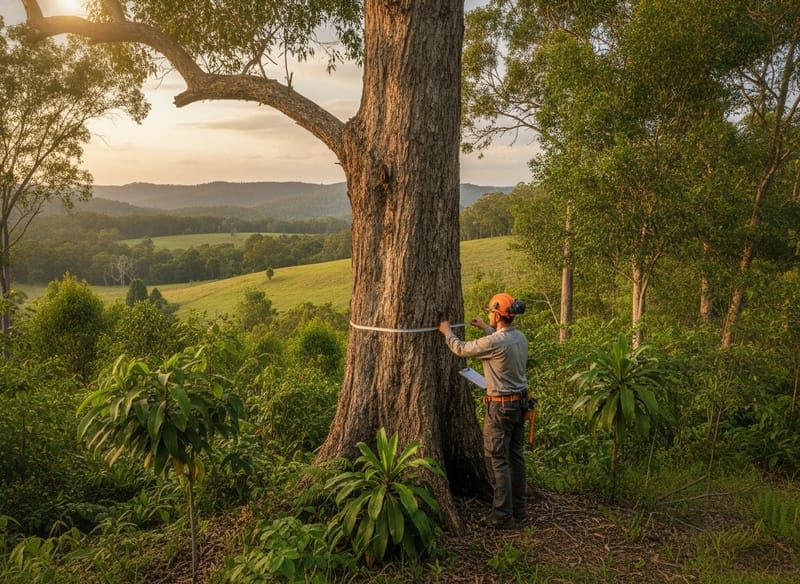
Our AQF Level 5 arborist inspects each tree, recording species, height, DBH, canopy spread, health, and structure.
We calculate TPZ and SRZ figures, evaluate defect severity, and review relevant council overlays.
We compile a structured written report with high-resolution site maps, tree data matrices, and recommendations.
You receive a finished PDF ready for direct submission with your planning or building application.
Whether you are planning a new build on acreage, navigating a neighbour dispute, or preparing a development application, securing a comprehensive Arborist Report Little River is the critical first step. At Werribee Arborist, we provide AQF Level 5 consulting arborist reports that give you absolute clarity on the health, safety, and retention value of trees on your property.
Little River properties often feature sweeping native grasslands, established windbreaks, and ancient River Red Gums that require careful management. A formal arborist report is frequently mandatory when dealing with the Wyndham Planning Scheme, particularly for lots larger than 0.4 hectares or sites triggering Clause 52.17 native vegetation controls.
Our team understands the specific pressures of our local climate, from heavy reactive clay subsoils to fierce summer northerlies. We deliver accurate, objective, and detailed assessments that satisfy council requirements, helping your project move forward without costly delays or unexpected compliance hurdles.
A common mistake homeowners and developers make is relying on a standard tree worker's quote or a brief letter from an unqualified tradesperson when the council actually demands a formal assessment. Wyndham City Council will reject development applications or removal requests that are not backed by an AQF Level 5 consulting arborist. Submitting a substandard document leads to frustrating delays, requests for further information (RFIs), and stalled construction timelines. Worse, inaccurate mapping of Structural Root Zones (SRZ) or Tree Protection Zones (TPZ) can result in irreversible damage to protected River Red Gums during earthworks, exposing property owners to severe council fines and legal liability. At Werribee Arborist, we solve this by delivering meticulously researched, legally sound reports. We apply rigorous Visual Tree Assessment (VTA) methodologies and strictly adhere to AS4970-2009 (Protection of Trees on Development Sites). Because our team understands the local heavy clay soils and drought-stress factors affecting Little River trees, our retention values and risk ratings are grounded in scientific reality. We provide you with clear, actionable documentation—whether it is a tree protection plan for your builder or a risk assessment for a hazardous Drooping Sheoak near your fenceline.
Our AQF Level 5 consulting arborists utilise industry-standard methodologies to assess, document, and report on tree health and structural integrity across the Werribee region.
Comprehensive site inventories detailing tree species, Diameter at Breast Height (DBH), Safe Useful Life Expectancy (SULE), and retention values to satisfy Wyndham City Council planning requirements.
Precise calculation of Tree Protection Zones (TPZ) and Structural Root Zones (SRZ). We outline mandatory exclusion fencing, root mapping, and mulch protection strategies to safeguard retained trees during construction.
Systematic, ground-based evaluation of a tree's biomechanics. We inspect for fungal decay, structural defects, included bark, and root plate heave, which is common in Little River's reactive clay soils.
Formal evaluation of hazard potential and target zones. We document the likelihood of failure and potential consequences, providing duty-of-care evidence for schools, acreage owners, and property managers.
Detailed documentation required when seeking council approval to remove protected native vegetation, including dead or dangerous trees covered by an Environmental Significance Overlay.
Navigating council requirements can be daunting, but our reporting process is designed to be seamless, transparent, and strictly aligned with local planning schemes.
Every report we produce is authored by an AQF Level 5 Diploma-qualified consulting arborist, which is the mandatory credential required by Wyndham City Council and Victorian planning authorities.
Our field assessments and tree protection plans strictly follow AS4970-2009 (Protection of Trees on Development Sites) and AS4373-2007 (Pruning of Amenity Trees). When assessing bushfire-prone acreage in Little River, we also factor in AS3959 construction requirements and Asset Protection Zone (APZ) guidelines.
Werribee Arborist operates fully insured with comprehensive Public Liability, Professional Indemnity, and WorkCover policies, ensuring total peace of mind when we provide expert consultancy and safety recommendations for your property.
Providing a reliable Arborist Report Little River requires deep local knowledge of the Werribee Plains environment. This area experiences some of the lowest rainfall in southern Victoria, combined with severe summer northerlies and highly reactive clay soils. These conditions frequently cause sudden summer limb drop in remnant River Red Gums and drought stress in planted windbreaks.
When planning development or tree removal here, property owners must navigate specific Wyndham City Council controls. Many acreage properties fall under the Clause 52.17 Native Vegetation regulations, where removing indigenous vegetation on lots over 0.4 hectares triggers a permit. Properties near the river may also be bound by the Environmental Significance Overlay Schedule 1 (Waterway Corridors).
Our team understands these local nuances intimately. We know how to accurately assess indigenous species like Drooping Sheoak and River Red Gum, ensuring your reports reflect the reality of the local climate and strictly adhere to local planning laws.
Once your report is submitted and approved by council, the focus shifts to executing the recommendations. If your report includes an AS4970 Tree Protection Plan, it is vital to establish all mandatory exclusion fencing and mulch zones before any heavy machinery enters the site. For risk assessment reports recommending formative pruning, deadwooding, or hazard reduction, always ensure the physical tree work is completed by an AQF Level 3 climbing arborist in accordance with AS4373 standards. If site conditions change, or if a retained tree shows signs of decline following extreme weather or earthworks, contact us to reassess the structural integrity.
Arborist report pricing is based on the number of trees assessed, the complexity of the development, and the specific planning overlays involved.
We provide transparent, fixed-price quotes for all consulting arborist reports with no unexpected revisions.
Our consulting arborists provide reports across Little River and all surrounding suburbs in Wyndham and Greater Geelong.
Get professional tree assessments and development reports tailored to Wyndham planning requirements.
Get a Free Quote